
Griffin Dunne on Hollywood, Practical Magic & the Rescue Dog Who Stole His Heart


Actor, director, producer and author Griffin Dunne joins Jill Rappaport for a fascinating and deeply personal conversation about his extraordinary Hollywood career, famous family and the rescue dog who stole his heart. From his memorable roles in Martin Scorsese’s After Hours, An American Werewolf in London and NBC’s This Is Us to directing Nicole Kidman and Sandra Bullock in the beloved film Practical Magic, Griffin shares stories from more than four decades in Hollywood.
Griffin also opens up about growing up as the son of legendary writer Dominick Dunne, his relationship with his aunt Joan Didion, the tragic loss of his sister Dominique, and how his family transformed unimaginable heartbreak into advocacy for crime victims. He also reveals that his acclaimed memoir, The Friday Afternoon Club, is being developed by Netflix, with Griffin set to direct.
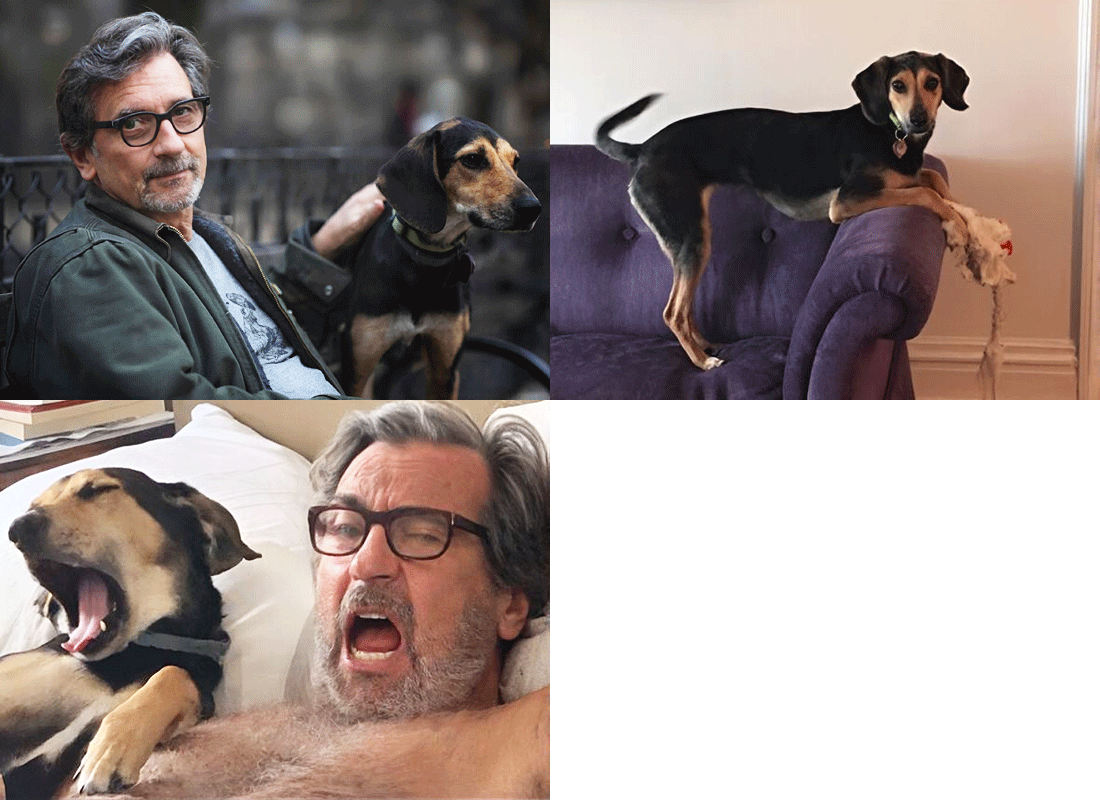
Then the conversation turns to Griffin’s greatest love—his rescue dog Mary. He shares the touching story of finding her at a shelter after losing his previous rescue dog, Lucy, and explains why Mary has become his constant companion and true soulmate.
Plus, cat correspondent Deborah Cribbs visits the Humane Society of Greater Dayton to explain how fostering cats and kittens can save lives, help overcrowded animal shelters and prepare homeless pets for successful adoption.
It’s a revealing conversation about Hollywood, family, loss, rescue animals and the extraordinary bond between people and their pets.
Listen to Episode #89 Now:
BIO:
Griffin Dunne is an American actor, producer, and director born on June 8, 1955. He is best known for starring in An American Werewolf in London and After Hours, directing Practical Magic, and releasing his bestselling memoir, [The Friday Afternoon Club].
Early Life and Family
Born Thomas Griffin Dunne in New York City to producer Dominic Dunne.Grew up in a prominent family that included writer aunt Joan Didion and uncle John Gregory Dunne.Siblings include late sister Dominique Dunne and brother Alex.
Acting and Directing CareerActing:
Breakthrough roles include Jack Goodman in An American Werewolf in London (1981) and Paul Hackett in Martin Scorsese’s After Hours (1985), earning a Golden Globe nomination. Other notable credits include Dallas Buyers Club and TV's This Is Us.Directing: Made his feature directorial debut with Addicted to Love (1997) and directed the hit adaptation Practical Magic (1998).
Accolades: Nominated for an Academy Award for his 1995 live-action short film, Duke of Groove. Directed and produced the documentary Joan Didion: The Center Will Not Hold (2017).WritingReleased his critically praised family memoir, The Friday Afternoon Club, in June 2024, which became a New York Times bestseller.
Transcript:
Welcome to Rappaport to the Rescue. I'm Jill Rappaport. My guest today really puts the D in diversified.
Griffin Dunne has really done it all on both the big and small screen. I just loved him on the NBC dramatic series This Is Us. Producer, director, and author, with a career spanning over four decades, earning Oscar, Golden Globe, and Emmy nominations, while alongside winning an Independent Spirit Award.
Of course, Griffin Dunne will always remain known for his cult classic roles in An American Werewolf in London, and who could forget him in Martin Scorsese's After Hours, which he also produced. And Griffin directed one of my favorite films, Practical Magic, starring Nicole Kidman and Sandra Bullock, which is now going to be a sequel. And he had also one of the most colorful and fascinating childhoods growing up as the son of the legendary writer, investigative journalist, and producer Dominic Dunne.
So when we come back, we will catch up with the very diversified Griffin Dunne, who will also talk about his truly greatest love of his life, his dog. Stay tuned. Welcome back to Rappaport to the Rescue.
I'm Jill Rappaport. My guest today, as you heard in my intro, has had quite the fascinating life and career. But I was reading an article about him in Town & Country magazine that truly sums up just how unique Griffin Dunne's life has been.
And I'm going to quote. Here it is. There isn't much that Griffin Dunne hasn't tried.
He's been an actor, director. He's hawked popcorn at Radio City Music Hall. He's worked with Madonna and Martin Scorsese.
He's been roommates with Carrie Fisher and has gotten stoned with Harrison Ford. Does it get any better than that? I don't think so. Griffin Dunne, welcome to Rappaport to the Rescue.
Thank you. I didn't see that in the magazine. I just looked at my picture.
I didn't know they wrote something. I loved it. That's me looking at the picture.
I did. Yeah, me too. I did a very elaborate intro of all your career and your accolades and your nominations.
And then I came across this article and I thought, that's the best. Let's go with that. I love it.
Well, talk about a colorful life. And yours really started in your childhood, growing up in the family that you did. Obviously, your father, the legendary journalist and reporter and amazing human being and writer, Dominic Dunne.
Tell us what your childhood was like. Well, you know, coincidentally, in last week's issue of New York Magazine, I sort of relived with my father my childhood and adult life. And an article I wrote about his obsession with obituaries and how he might place, you know.
And when I was very young, you know, he loved movie stars. He loved Hollywood. He loved all movies.
And, you know, he didn't talk to me like I was a kid. And, you know, I mentioned this in the article. He's reading the obits to me.
And I'm like seven. And he said, Oh, cheerful. But we're Irish Catholics.
So we're dark is nice, Ed, in our humor. And he goes, You know what? David Selznick got on the front page of The New York Times. And we lived in L.A. In those days, it took two days for The New York Times to get there.
So David Selznick had been dead for two days. And he was very, very funny and liked to play kind of jokes on us when we were kids that fake heart attacks and stuff like that. I'm making him sound so morbid, but we loved it.
And as their marriage to my mother went on, they were they they became quite unhappy. And my father, you know, went through a really dark period with, you know, alcohol and drugs and it ruined his marriage. And he was closeted, which, you know, was in those days being in Hollywood, that would ruin your career.
It doesn't matter if you're in front or behind the camera. If you were, you know, out and you went to bars, you could be rounded up and arrested. You know, it was a scary time to to be closeted.
And he was so close with so many of the biggest actors in the industry that would frequent your home. Yes, yes. He would.
Oh, well, that's the other thing that was part of his character is parties. He was an extremely social person and he gave parties. I grew up with them hearing grownups getting hammered downstairs and.
What stars? Tell me the names. Who was hanging out? John Connery. Billy Wilder was there quite often.
A lot of the movie stars that were at the biggest in the 30s and 40s were sort of on the on the downside in this by the 60s. But Joseph Cotton, Natalie Wood was my mother's closest friend. And directors like George Stevens and William Wyler and John Huston, you know, it was the greatest filmmakers of their time.
And when I was a kid, if the guy who directed or starred in It's a Mad, Mad, Mad, Mad World, I would have jumped up and down and gone crazy. But, you know, I wish I had this brain to talk to Billy Wilder about movies at that time, but they were just grownups to me. Yeah.
So that was just like a normal day. You know, if Natalie Wood walked in and was having coffee with your mom, it's like, oh, it's Natalie. It's Natalie.
It's Natalie. All right. But did it shape who you become? I mean, did you know you were going to go into the industry because of the life you had and that you grew up with? I pointedly did not want to get into the industry.
When I went to high school, by the time I entered high school, I was a terrible student, very dyslexic, but I wanted to be a writer, particularly a journalist. And my aunt and uncle, John Gregory Dunne and Joan Didion were very well-known journalists and brilliant. And you did a documentary about her, right? I did a documentary about Joan, yeah.
And so I kind of wanted to follow in their footsteps and have it be less Hollywood. You know, I was aware of, you know, Tinseltown and, you know, the phony people in Hollywood and all that stuff. So I pointedly went to New York.
Well, my writing career, such as it was, got sidetracked in high school when I got kicked out of school. But I had also started to act and really took to it. So when I got kicked out of school, I didn't go to college.
I went to an acting school in New York. And that's New York is where I wanted to live. I just knew that from a very early age, since I first saw the city.
Not Hollywood. And so I came to New York and thought I'd just do the theater. But that didn't happen.
I mean, I did some theater, but ended up really producing a movie before I actually got a good part in a movie. You know, it was a very backward kind of way to approach. And your career, I mean, I would imagine being the son of someone like Dominic Dunne, he must have been mortified when you got kicked out of school.
I mean, here he was, this incredible writer, journalist like that would be a major blow. Well, you know, at that time, he had by that time, really, he'd been washed up in Hollywood and no one would return his calls. And he had lost his friends and his money and all these prized possessions.
He sold in a garage sale and he had a real dissent. And it happened at the time, Hollywood, you know, just dumped him ruthlessly at the same time I was entering the business. So I've always thought Hollywood, rightly so, it can be a scary place.
And so I entered into it kind of warily. He was upset about high school. My mother was actually more upset and I was upset because the night before I got caught smoking a joint, hash to be specific, I was the next night to premiere as Iago in Othello.
And I was haunted that I never got to play that part. You know, I told my parents that I was going to take a bus home and so I could think about my sins. And really, I hitchhiked home from Colorado to Los Angeles and took a lot longer than a bus and just got into even more trouble.
I don't know how my parents put up with me. I gave them a run for their money. It's really interesting because so often in Hollywood, we hear about nepotism, you know, the son of, the daughter of.
Yeah, yeah. You entered a time where your father was just persona non grata, which in essence should have made it more difficult for you to enter the industry. Yeah, well, it certainly wasn't a name I could use as a calling card.
But, you know, he was so proud of me. He was tickled pink that I produced a movie when I was so young. And every accomplishment that I had, even when he moved to, he didn't move.
His car broke down trying to get out of L.A. He drove till the car broke down in Oregon and lived in a cabin for over a year and got sober. And, you know, even then when he was just at his worst, whatever I was doing made him so proud and just lifted his spirits. And look at the projects you've been involved with.
Right before we started this interview, Mark Winter, the founder of Pet Life Radio, was raving about you in This Is Us. Of course, I'm a big fan from your movies and your producing and your directing. You've done it all.
I mean, what projects really are embedded in your soul that you think, thank the Lord I got that gig? I would say, I would say on a personal level, I'm most proud of the documentary I made about my aunt, Joan. Joan Didion. Joan Didion.
And I was the only one she allowed to do that. Many people, of course, tried for, you know, decades. But I recognized it was toward the end of, you know, her life.
And I saw that she was getting Parkinson's, was starting up. And she allowed me to tell her story. And the thing I'm most proud of was, well, one, the night it premiered at the New York Film Festival, Alice Tully Hall, it was a big theater.
It got a huge standing ovation. I mean, a longest standing ovation. And we're in a balcony and she's in a wheelchair.
And the balcony railing was so low, I was afraid that if I pick her up, I was afraid she'd fall over. And we're quite high in the air. We're hit with a spotlight.
And she looks up at me and goes, hey, get me up. And I'm holding her up. And this went on and on.
It was really the longest standing ovation in the film festival's history. And but they were doing it for her. It wasn't like, oh, what a great move.
They certainly liked the movie, I presume. But they were thanking her for her life's work, for all the things that she'd done, writing from a different angle that no one else had seen, that was often prophetic and having that unique voice. And, you know, writers don't get the chance to get standing ovations.
You know, it's a quiet job and it's a relationship, a one-on-one with a reader. You don't have 1,200 readers at once thanking you. So it was a very emotional moment for both of us.
So certainly, I mean, after hours, that'll be on my obituary. That'll be the line of after hours. And working with Martin Scorsese, I mean, come on.
I mean, and just in front of the camera, behind the camera, it seems that all great actors aspire to be directors. And you've been able to do that as well as producing. Yeah.
Many actors are really natural for it. I mean, they've seen how a set works and their relationship. They've already won half the... Everything's so much about casting.
And if they cast correctly, they'll be with actors that know they're being directed by another actor. So there's already immediate trust factor. And it's ridiculously fun directing.
It's all-consuming. Well, you know, one of the things I love about you and I've always heard over the years is that people just think you're a great guy. That is the general consensus.
Oh, really? I gotta tell you, not to embarrass you. I was at a screening the other night of The Invite, the new Seth Rogen film. I saw, yeah.
Yeah, I went up to an old friend of mine by the name of Tom Freston, who I used to work with, right? I used to be on a show, Flix. He was head of MTV. And my first question was, how's Carrie doing? Carrie Lowell, who you were married to and have a beautiful daughter with.
Absolutely, mother of my kid. That's right. And so Tom's asking me what I'm up to.
And I said, I'm doing a podcast. He goes, oh, great. And tell me about your guests.
And I said, oh, I've had the best guests in the world. I can't even believe I get these names while I'm sitting in my living room. He goes, oh, that's great.
Well, tell me, who's your next guest? I said, Griffin Dunne. And he said, oh, my, that was Carrie's favorite ex-husband. That's what we say about each other.
That's right. Of all our exes, you're my favorite. I love that.
But again, it just goes to show that the world seems to adore you, Griffin. It says so much about you. No, well, thank you.
Very nice. Well, it shows something about how you are, how you work with people. And you've worked with the biggest names in the business.
I mean, we were talking about Practical Magic, which you directed, and now is going to be a sequel. You worked with, back then, Nicole Kidman. She was already up and coming.
And Sandra Ork. And look at the career and what you've done. And now this new sequel coming out.
Do you keep in touch with these stars? Do you maintain relationships? I haven't seen Nicole in a while. I used to see her quite a bit. I was married to an Australian, and they were friends.
But I haven't seen her recently. Sandy and I have always stayed in touch. She's just the greatest.
And she's an animal lover like us. Huge with the dogs, right? And yes, absolutely. And you know what's amazing, though? I mean, the relationships that you formed with these people.
And back then, you know, I talk about Practical Magic. I knew that film was so special. I just loved it.
The dialogue, the music, everything about it was spooky. It was funny. It was great.
What do you aspire to do since you have had your fingers in all sorts of pies in this business? You talk about the documentary really speaking to your core and your soul. Is that what you would like to continue to do? Are you open for more movies, TV shows like This Is Us? Yes. Well, you know, there's more opportunity with streaming now, you know, in television.
And, you know, movies are every now and then you see a great one that other people are going to see, like The Invite, which I just loved. Didn't you? Brilliant. Yeah.
And movies that size don't usually get many eyeballs on them and they don't last long in theaters. But what I'm doing probably that's gonna, I don't think, be any closer to my heart than this is, you know, Netflix bought my memoir. Which was fabulous.
The Friday Afternoon Club. Oh, thanks. And so the writing is in the works and I'll be directing that, which I'll be directing a little teenage Griffin and a six-year-old Griffin and all the rest of the people, which will be downright hallucinogenic.
But I'm looking forward to it. Time to hook up with Harrison Ford and get stoned again, huh? Absolutely. I'll relive it all.
When is this coming out on Netflix? Because the book was amazing. It literally just started. The writing process had just started.
Wow. And your childhood, you know, to relive that again, because the book really delved into every facet of your life. And the one part of your life that we all remember is the death of your beautiful sister Dominique by her then ex-boyfriend, which was so horrific at the time.
And then the sentencing, he basically got a pat on the wrist compared to... Yeah, no, it was, you know, three and a half years. What he should have gotten. Protecting someone's life.
Yeah. Yeah. And also the judicial system, particularly at that time, not a lot has changed, but there's still the, particularly for women, the blame the victim defense.
And you just try to destroy the reputation of the person who's been murdered so that you get sympathy with the jury. And, you know, we had a ridiculous figure of a judge and a very, what do you call it? Ruthless defense attorney. And everything that could have gone wrong went wrong.
Every day something went wrong. Like we couldn't believe it. But it changed all of our lives, of course.
But the thing I'm most proud of is the way it transformed my parents. You know, my mother had MS, multiple sclerosis, and she was in a wheelchair and it could strike any time. It could, the stress of the trial, the stress of the murder, everything.
We feared would make her worse. And she went every day, every day. The defense lawyer actually tried to have her thrown out because they thought her being in a wheelchair would prejudice the jury to feel sorry for her.
I can't believe they tried to throw her out. Just shows you. Yeah, that was a normal day.
And so what happened was my mother started a victim's rights group based on our shabby treatment. She realized this happens to a lot of families. This disregard and condescension and, you know, and being the face of the victim as survivors, you know, we were there to represent Dominique, you know.
So my mother started this group, Victims for Justice of Homicide. And it's a legislative group and they have passed laws helping. It started in California and have now been adopted in 25 other states.
And then my father wrote about the trial for Vanity Fair, the very first thing he'd ever had published in his life. And he became a star writer for Vanity Fair, quite famous, but quite famous for writing about the highest profile trials in America where other women were murdered or raped. And he made no pretense about being biased or not.
He was always on the side of the victim. And when Bill Spector murdered Lana Clarkson, you know, the press would just call her. Sometimes they wouldn't even use her name.
They just say the B-list actress. And they'd make jokes about her career. And dad would write and go that she's somebody's daughter.
That she's an actress, a working actress like his daughter. And he just made it all human for the readers. So it was less about what OJ's charisma in the courtroom, but more about Nicole and her family.
So, you know, if anything, I'm just proud that they took something unthinkable and turned it around to help others. And by you doing this new project with Netflix, which is based on your book, it really is going to pay such beautiful homage to your mother, your father, your sister, and their legacies. That's what I'm thinking too.
That's one of the most satisfying things from once the book was released and so many people were reading it. You know, people I didn't even know would just come up and go, God, I love your family. That's so beautiful.
Really, considering the relationships that you had with them and what everybody had been through in their lives. And, you know, Griffin, obviously you're on this show, our connection, our bond with our four-legged fur angels. And I thought I loved you just from a professional standpoint, but when I heard how you are with Mary, your hound that is, as I said in my intro, the true love of your life.
It's true. It's true. I have her in my bio.
You know, I live in New York with Mary. She slept through this whole thing. Oh, am I boring you, Mary? I'd like a little bit more activity there.
I'm getting a little nervous about my interviewing technique. Tell us about Mary and how she came into your life. Well, she's truly a Southern hound dog gal that you see in those old movies about the South sleeping on the porch.
You know, she sleeps all day. But I had a dog named Lucy. I have the best dog karma.
I only wish I had it with women. Lucy was also a rescue and I didn't want a dog to have a dog, but my daughter desperately wanted a dog. And I had a girlfriend at the time and she wanted a dog and they just came home with Lucy.
No permission. That was it. Well, you know, she lived till 11.
She was the most extraordinary dog ever. I mean, I've had now two dogs. I always have my least.
But if I just walk through the city, they'll follow along. They'll know I'm red light from a green light. It's like, they're just in calm, so calm.
And I live in the building in the East Village and she's the most popular member of the entire building. I mean, people go nuts for her. And children, she loves children.
My God, you know, and she's been around little kids in the building, like toddlers. She just goes up and smells them and then licks their cheeks. And they're just the best, right? I mean, no, and she smells flowers.
She doesn't pee on them. She smells them. And so she's now 10 years old.
And so my daughter got Lucy and then I, and I'm sure you know this, there's nothing quieter in a house than when your dog has passed. It just, it's like, it's a tomb. And you can never take for granted the space they fill in your lives.
How you're always aware where they are and you're talking to them, especially if you live alone. She's heard everything here. I mean, if she did have fingers, she would have called an ambulance or a shrink to come deal with me.
And, but she's just by my side. And in that case, so Hannah and I were both hurting, that's my daughter. So we drove to different shelters in upstate New York, you know, some 20, 30 miles apart, did this for days.
And we just didn't find the right Lucy vibe. And at the very end of the day, I hear her on the phone. She's calling the last rescue place in Patuxent.
And she says, I want a dog. We had a dog and described Lucy. But it's like this, it's very calm, gives all the, and the woman is talking to her going, you have to make an appointment.
You have to make it. And we're closing. We're closing any minute.
You can't, you have to go, you know, don't come over. She goes, we'll be right over. She said, don't come.
We showed up. And the woman behind the desk went, oh, okay. She goes, well, I think this is the dog you were talking about.
And out comes Mary, like three month old Mary. She'd just been picked up a few days before off some street in North Carolina. A little ear come torn up and some, by some other dog, I presume.
And, and we just looked at her and, and the lady goes, now we just for paperwork, we called her Mary, but you can call her whatever you want. That's perfect. She looks exactly like Mary.
So next we went to Petco and I had a tag made and it says, I am Mary Dunne with a phone number. If God forbid she gets lost. And it's been a long story ever since.
I just love to hear that. And I know she really is so comforting to you. It doesn't matter what project you're working on, what friends are hanging out with you.
She really is the soulmate, isn't she? Without a doubt. She really is. That's the message of this whole show.
That's what it's all about. I always say they rescue us, right, Griffin? They really do. They really do.
I mean, I'm not particularly religious and this sounds corny and like probably a title of somebody else's book about horses, but they really are like God's creation. They're just something like, how do they know? How do they love that much? That devotion and understanding and listening. And you know, maybe not all dogs are like that.
And even more so the rescues, they know when they've been rescued. That's what I'm talking about. I know it's just remarkable and absolute gratitude.
And they get it right away. As soon as you take them, they go, oh, great. I know where I am.
I get it. I know who you are. Oh, thanks so much.
What's for dinner? It's like it was meant to be that she found her way to you. Absolutely right. Absolutely right.
Griffin, this has been such a fascinating discussion. You know, I'd never gotten to meet you before. I've been such a fan for so many years and admired everything you've done and just couldn't believe your whole life and what you've gone through.
And you're just really a very special human being. And I'm so glad that the Netflix project is going to come to fruition so everybody can learn about your incredible life. Well, this has been really fun talking to you.
And I could talk about dogs all day long. Pick up the phone and call you right after. Yeah, let's talk after.
Oh, Griffin Dunne. Thank you so much. And you'll be happy to know when we come back, we have a cat correspondent named Deborah Cribbs and she shares her love and her wisdom with our felines all over and how to make life better for them.
So you're going to want to stay tuned for that segment. That's great. And thank you so much.
And give a big kiss to Mary if she's not sleeping. She's still asleep. Look at her.
But I want to say thank you for your devotion to rescues and making people aware. And it's why I particularly look forward to speaking to you. Aw, thank you, Griffin.
Yeah, like, you know, they say when you do what you love, you never work a day in your life. So it's what I love. It's my oxygen.
That's so great. Lucky you. Thank you, Griffin.
This was great. All right. Thank you.
And thank you all for joining us on this really wonderful edition of Rappaport to the Rescue.
Welcome back to Rappaport to the Rescue. I'm Jo Rappaport. Now we are off to Ohio at the Humane Society of Greater Dayton, talking about one of the most important ways people can help shelter animals, fostering.
I call it God's work. I've done it before. It has changed the lives of those animals.
You are the bridge between the shelter system and a forever home. And it is so important to get them into that loving home and let them learn about the most amazing ways you can help them in the loving touch of a human so that they're ready and accepting of their next forever chapter. Now it also helps shelters save countless lives.
Joining me to talk about this really important topic in detail is our CAT correspondent, Deborah Cribbs of the Give Them 10 movement. Deborah, so great to have you back. And you know, fostering, this is near and dear to my heart.
Absolutely, Jill. This is one of my favorite topics of conversation. And as a CAT correspondent for you, I am delighted to talk about this during this segment.
And we are still in kitten season, Jill. So it's a very timely conversation for the summer. You know, I think of fostering as the angel world of CAT welfare.
If you are a foster family in the human world, we probably already realized, right? These are angels. Well, in the pet world, excuse the noise behind us, Jill, the kittens at Dayton Humane are having some fun. We love that noise.
We do love that noise. But you know what, Jill, these kittens need to be in foster. And Dayton Humane here has a really great foster system.
So I bet they will. But let's talk about fostering. They are the champions.
The foster families are the champions of the animal welfare community. And you know what, even if you're only fostering for a few days, we like to say you can change a cat's life. If you and your family will just make a space for a cat, a couple of cats, a pregnant mama, a litter of kittens for as little as five days.
And you know what, I think people don't realize that, first of all, that you can help in just a few days. But second, you don't need a big house. You just need a space, a spare bathroom, part of the garage, you know, just anywhere that can be safe for a cat or some kittens to be.
And it would make a huge difference in that cat's trajectory. And you know why? Yeah, because the home environment is so important, right? Exactly. Exactly.
I think people underestimate. Right now, Dayton Humane, where I am right now, this beautiful shelter, these cats are well cared for. They are adopted very quickly because Dayton Humane does a really good job.
But any cat or dog for that matter, is really better off being trained in a human environment and a home environment, sensitized to being around humans. So especially with kittens, if we give them the opportunity to be in a foster home, even just for a few days, it allows them to know what it's like to be in a home. And then they probably will succeed better with their adoption because they'll know what it's like.
But it also, Jill, allows us to keep kittens together. When they're a litter, like right now we're in kitten season in the United States, there are lots of litters of kittens. So these kittens really do better for those first important, just a few weeks.
It's really just a few weeks before they can be spay neutered and then adopted. They do better together. So we love foster programs for sure.
Well, I said at the top of the show, it's truly God's work. I have fostered before and it meant so much to me. It was such a great gift to see them go on to their forever home.
And let's talk about that because I know so many people, the old expression, we become foster fails, which means we end up keeping the beloved little dolls because we can't part with them. And a lot of people are afraid of that, you know, that their heart is in the right place, but they think I can't foster because I know I can't give them up at the end. Well, we do call it a foster fail.
In fact, it is, and here's why. It is so important in animal welfare that we have the ability to put these cats and again, dogs into a home environment for a brief period of time. It is such an important part of the process for the reasons that we just said.
I think as somebody who has done this before, I have fostered before, you have to go into it understanding you are a very important cog in the wheel of the success of these animals. And if you care about these animals, and I know that you do, and I know people who foster do, you go in with that idea that you are the first safe place that these cats are going to land. It is your job to get them to their forever home.
And as such, you feel great joy, Jill, great joy. And they get used to the human touch, the bond, the love, the care. So you make them more viable for permanent adoption.
Exactly. So that is your job. That is your quest as a foster family.
And the end game is that you give that cat back to the shelter for adoption. You can even follow where that cat lands, because all of these shelters are going to be able to tell you that, that they land well. And then, Jill, when your family is ready, maybe right away, maybe not, you do it again.
You are always available to take the phone call from the shelter that says, hey, we have a pregnant mama, or we just had five kittens dropped off. You'll take the phone call if your family's ready. You do it again.
It is angels work for sure. I think people also wonder, will it cost them? Most shelters, here where I am, date and humane. They give the food, right? Yeah.
They offer all the things necessary. I think the most difficult or challenging part of fostering would be neonatal kittens. So little bitty babies.
And there are very special protocols and special training that you go through with the shelter partner to be able to do that. But the shelters actually offer the help financially if you need that, if your family needs that to do it, but you don't have to have the financial burden yourself, but you can still be helpful. Absolutely.
Great information, Deborah. And again, there's so much we can do. If you can't adopt, this is the way to go.
And especially now when our shelters are overloaded, really important to get in and help today. Deborah Cribbs wonderful information. And thank you all for joining us on this special edition of Rappaport to the Rescue.
Foster, foster, foster.
"Rappaport to the Rescue" Theme Song Written & Produced by Mark Winter
© Copyright 2022 Such Fun Music (ASCAP)